The Deyne School of Music: Festivals 1941 – 1944
Andrew Holmes, Documenting Northern Lincolnshire's History Project Volunteer
Introduction
In 1943, Laura Middleton and Percy Cossins a married couple in Scunthorpe established a remarkable music school. Laura was known affectionately by her maiden name as Miss Middleton. Originally known as Deyne Music Studios, the Deyne School of Music was a well-respected institution for pianoforte teaching. For many pupils, amidst the turmoil of the Second World War music provided solace.
Middleton and Cossins were passionate about sharing the joy of pianoforte music. The couple had for several years organised music festivals and concerts. Work that continued after the founding of the school.
1941
In 1941, when the Luftwaffe was doing its best to pulverise England into submission, Middleton and Cossins gave the first of their annual concerts. The concert was held in St. Paul’s Church Hall in Ashby on the evening of Tuesday 25 March 1941. Despite the blackout, and the immediate threat of bombs, music was played to a packed audience. Assisting were:
- Mrs. M. Fookes (soprano)
- Mrs. M. Wilde (elocutionist)
- Mrs. N. Varty (adjudicator)
- Laura. E. Middleton (accompanist)
A popular feature of the programme was a pianoforte duet on three pianos. Joyce Walker and Muriel Mowson were at the first piano. Middleton and Cossins at the second, with Kathleen Boston and Barbara Fardell at the third.
Barbara Fardell was a star pupil who was born in Messingham. Fardell commenced pianoforte studies when she was 7 years old. By the time she was 13 she was a consistent prize winner at musical festival competitions. Fardell passed all the Royal School of Music examinations, from preliminary to advanced stages. Upon leaving school, she joined the Deyne Music Studios as pupil-assistant, soon gaining her teacher’s diploma.
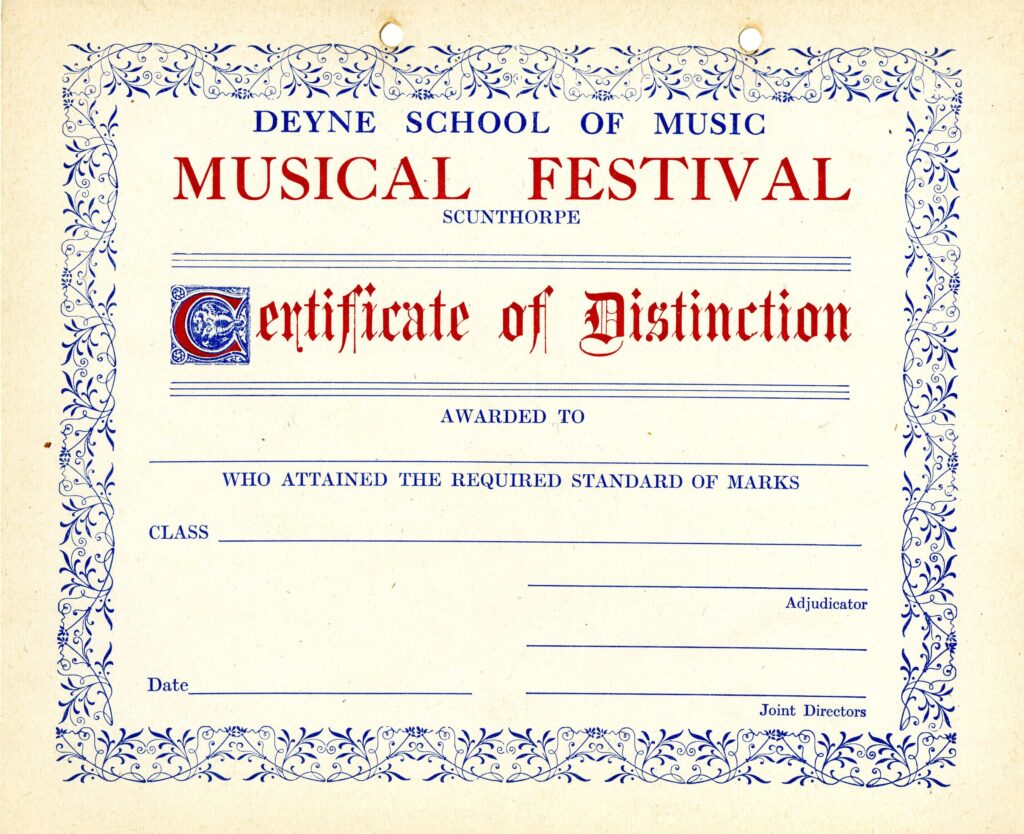
The object of the 1941 concert was to give parents an opportunity to assess the progress made by the pupils over the course of the previous year. W. Leigh England Esq. J.P. of Grimsby presided. Mrs W. L. England presented the prizes and certificates to those pupils recording passes at the Royal Schools of Music examinations.
1942
The second annual pianoforte concert and distribution of certificates took place at the Savoy Theatre in Scunthorpe on Saturday 25 April 1942. The concert included over 50 performers and 6 pianos. Plus, a popular recital by the famous broadcasting and concert artist, Reginald Paul. Paul ranks as one of the greatest virtuosi of the day, and as a modern master has few equals. A famous critic described him as a musician first and a virtuoso afterwards. Musical instincts which make his interpretations of piano masterpieces so inspiring and delightful.
Paul had appeared on principal concert platforms throughout the country. He had further enhanced his reputation by his many broadcasts. This concert was under the patronage of the Mayor and Mayoress of Scunthorpe (Coun. F. and Miss. E. Clarke). The Mayoress presented certificates to successful students. All proceeds were in aid of Scunthorpe War Memorial hospital. Regrettably Paul’s recital was brief and there were many requests for a return visit of this great pianist. He returned on Saturday 3 October 1942 to St. Paul’s Church Hall. There he was supported by a two-piano recital by pupils of the Deyne Music Studios. The aim of this recital was to maintain the high standard of music during war-time. As well as raising funds to promote a non-competitive festival. Non-competitive festivals were introduced in 1927. Such events had been organised throughout the country with very far-reaching results. Interest in music was greatly stimulated amongst teachers, parents and children alike. That the festival would be a conspicuous success was ensured by the engagement of the famous composer, Royal Society Professor and pianist, Felix Swinstead, as adjudicator.
1943
For the Third Annual Distribution of Certificates and Prizes, Deyne Music Studios did not provide a pupils’ programme. Instead, a report on the work of the previous year was shared. This report demonstrated how the music studio’s efforts had continued to foster interest in pianoforte music.
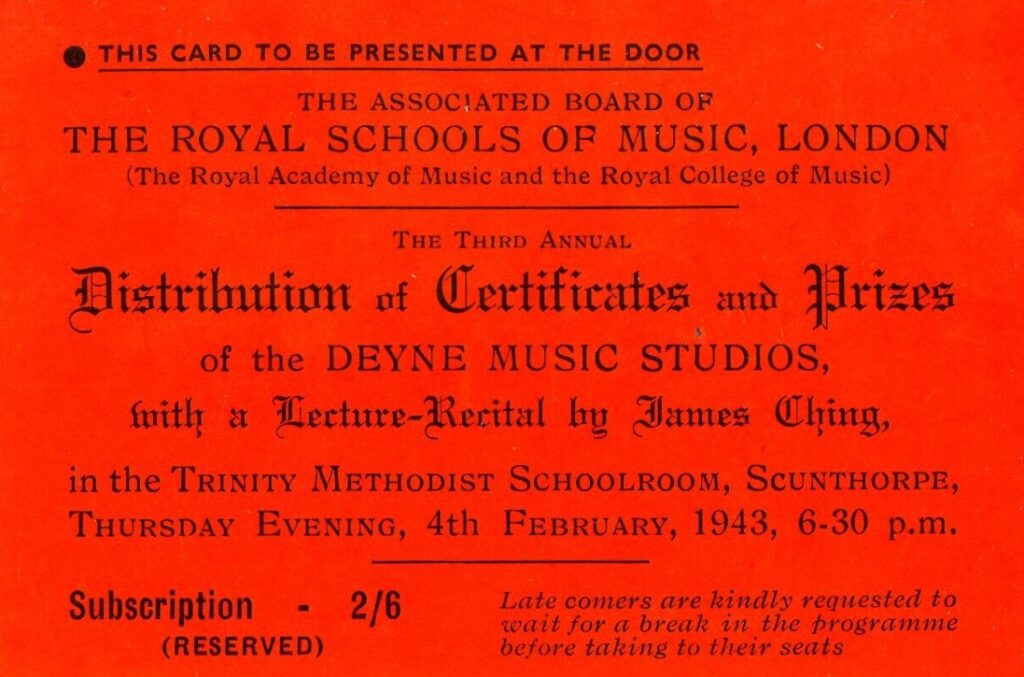
The event was held on the evening of Thursday 4 February 1943 at the Trinity Methodist Schoolroom, Wells Street, Scunthorpe. Pianist James Ching, recognised as the foremost English interpreter of Bach’s piano music, gave a lecture recital. Since 1928, Ching had been well known for broadcasting Bach’s music to all parts of the world. Councillor James R. Heslam presided along with the Mayor and Mayoress of Scunthorpe, Alderman and Mrs John. A. Jackson. The Mayoress making the presentation of certificates and prizes.
Also in 1943, a pianoforte festival was held during Easter week, Sunday 25 April – Sunday 2 May. The event included a non-competitive festival for individual performers. Plus, a series of lectures and lecture recitals by world famous pianists and musicians.
Since the Second World War caused the Annual Musical Festival to be cancelled, there had been no large-scale public event in the town designed to encourage music making among young people. The enterprise of Cossins and Middleton resulted in about 1000 entries. For the first time in Scunthorpe, the Deyne Music Studios held lecture recitals by distinguished artistes on six nights of the week for the benefit of old and young alike.
The special opening programme commenced with a public recital on Sunday 25 April 1943 at the Savoy Theatre by the world-famous Russian pianist, Mark Hambourg. He chose his pieces from three musical periods – from the early English composers to the nineteenth century (romantic) and Twentieth century (modern) schools. Selected items of Purchell, Chopin, Handel, Beethoven, Debussy, Bach and Tchaikovsky were reportedly given “with that mastery and strength which is strikingly inimitable”.
“It was a memorable evening’s programme. Each piece was prefaced by the pianist’s own explanation, both serious and entertaining, in a charm of manner which captured the heart of his audience, and he often favoured them with favourable encores”.
Scunthorpe and Frodingham Star’s report on Saturday 1 May 1943
The classes for the individual performers began on the Monday with the senior section. Professor Swinstead was pleased with the high standard of the entrants. The classes were held in the Centenary Methodist Schoolroom on Frodingham Road. The Mayor of Scunthorpe, Alderman John A. Jackson opened the non-competitive festival at 7pm. He stated that people of Scunthorpe always welcome new ventures, such as this festival which has stimulated the taste for good music which already existed in Scunthorpe. He concluded by congratulating the organisers on their enterprise in tutoring the pupils, organising the festivals, and in engaging such celebrities in the pianoforte world. This was followed by a lecture recital by Swinstead entitled “What is the good of musical history?”.
Further non-competitive classes for individual performers took place on Tuesday 27 April at Centenary Methodist Schoolroom. In the evening a two-piano lecture-recital by well-known pianists, John Tobin and Tilly Connely, entitled “Two piano duets” took place. Tobin read various passages relating to music written for two performers on two pianos and on one piano. He showed the audience an original copy of the first duets ever written for the pianoforte. The two pianists then played variations by Brahms on a theme by Haydn. They also played pieces by Bach, and by way of contrast played pieces by British composers. The Scunthorpe Star newspaper remarked on how all the pieces were played with remarkable accuracy and precision and appreciated by a good audience.
Wednesday’s classes were for the junior children in the preparatory and primary grade stages. Throughout the day, Swinstead selected the best performers. In the evening there was a lecture recital by Ching entitled “Bach and the man in the street”. Ching explained that Bach led a very normal life and was considered by most people as just an average citizen. He worked hard as a teacher and an organist. Mr W.E Ramsden gave a vote of thanks to Ching for his excellent lecture, and to the organisers of the week’s festival.
Due to the large numbers of entries, Thursday’s sessions were held in two locations. Professor Swinstead was the adjudicator in the Centenary Methodist Schoolroom. Professor V. Langrish in the Trinity Methodist Schoolroom. In the evening a lecture recital by Swinstead entitled “questions I have been asked” also known as the “brains trust meeting” was held in the Centenary Methodist Schoolroom. This meeting was also attended by Langrish, the Rev. G. E. Ure, Mr. E. Curtis and Mr. T. J. Lewis. The purpose of the meeting was to answer questions which had been sent to the Deyne Music Studios. Cossins was the question-master and introduced the guests. Concluding, Lewis said how he appreciated what Cossins had done for Scunthorpe, and he hoped that everybody had derived something from it. Cossins replied that the aim was to further the standard of music. He added that Middleton had put in a large amount of work and wanted more people to join with them the following year to co-operate for bigger things.
Non-competitive class sessions were held for individual performers at Centenary Methoist Schoolroom during the day on Friday 30 April. In the evening, in the Trinity Methodist Schoolroom, Harold Craxton gave a lecture recital entitled “The dance element in keyboard music” to mark the closing of the non-competitive festival. Craxton can claim pupils from all over the world. Including many well-known teachers and performers. On Saturday 1 May, at Centenary Methodist Schoolroom, there was an evening concert featuring all the distinguished performers from the non-competitive festival. These represented all branches of pianoforte work, with around one hundred performers taking part.
The grand closing programme of Scunthorpe’s Easter week pianoforte festival took place at the Savoy Theatre. A two-piece piano recital by the world-famous duettists, Rawicz and Landauer, came as a fitting conclusion to the week in front of a full theatre. This also included a special performance of the Warsaw Concerto supported by Fardell and senior distinguished performers from the Non-competitive festival.
1944
By 1944, Deyne Music Studios had become known as the Deyne School of Music. The school had moved to new premises at 69 High Street Scunthorpe.
The fourth Annual Concert and Distribution of certificates was held at Trinity Methodist Schoolroom on Wells Street, on 17 February 1944. The event featured distinguished guests Bessie Rawlins (violinist) and Reginald Paul (pianist).
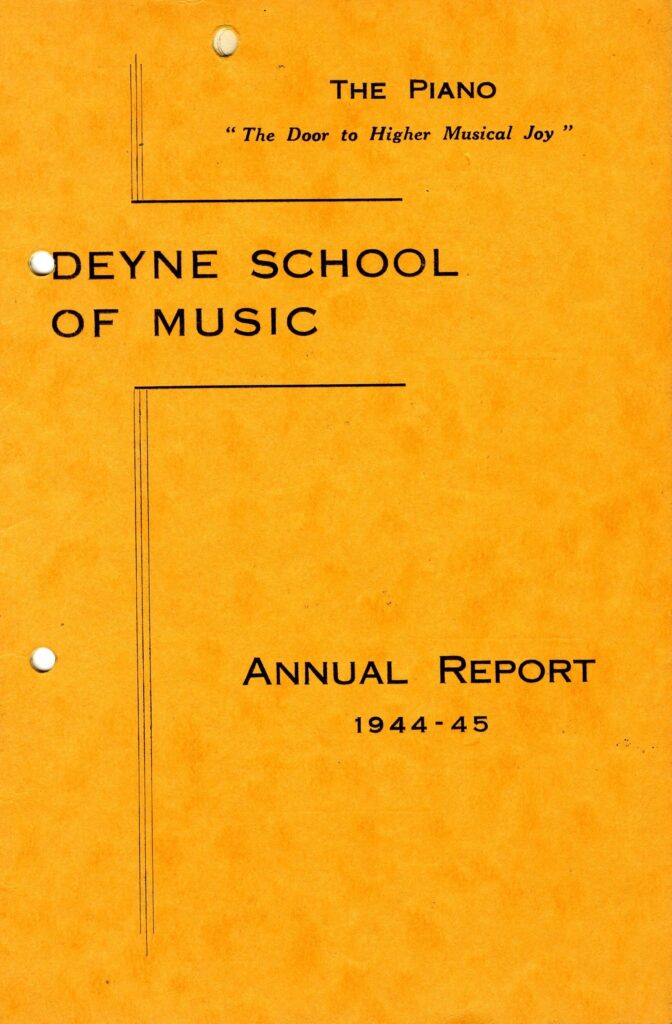
Cossins stated in his annual report that during the past year the school syllabus had been presented on musicianship lines, and the progress made had been very encouraging. In examinations, 74 pupils had met the requirements of the Royal Schools of Music, compared with 67 the previous year. Cossins suggested that before long music would become more important in the school curriculum than mathematics. In the report, he shared his image of a future that would require an army of skilled teachers with vision and personality. He suggests to those pupils whose work had reached advanced stages, that they should consider music-teaching as a profession. The new world after the war would need such teachers!
Paul remarked, before playing pianoforte solos, that he was much impressed by the school’s standard of playing. He added that it was a step-up since his last visit. It is evident that the experience pupils gained, hearing many famous pianists play, as well as experience competing at the 8-day pianoforte festival, had raised their work to a greater standard.
The evening was rounded off with enthusiastic applause from the appreciative audience. The Mayor, Councillor Mrs. A. Eyre, J.P. presented certificates and congratulated the pupils on their successes and hoped they would all aim high. Also in 1944, the Deyne School of Music presented their second Scunthorpe 8-day pianoforte festival. Commencing on 16 April, the festival opened at the Savoy Theatre with a public recital by the world-famous pianist, Moiseiwitsch.
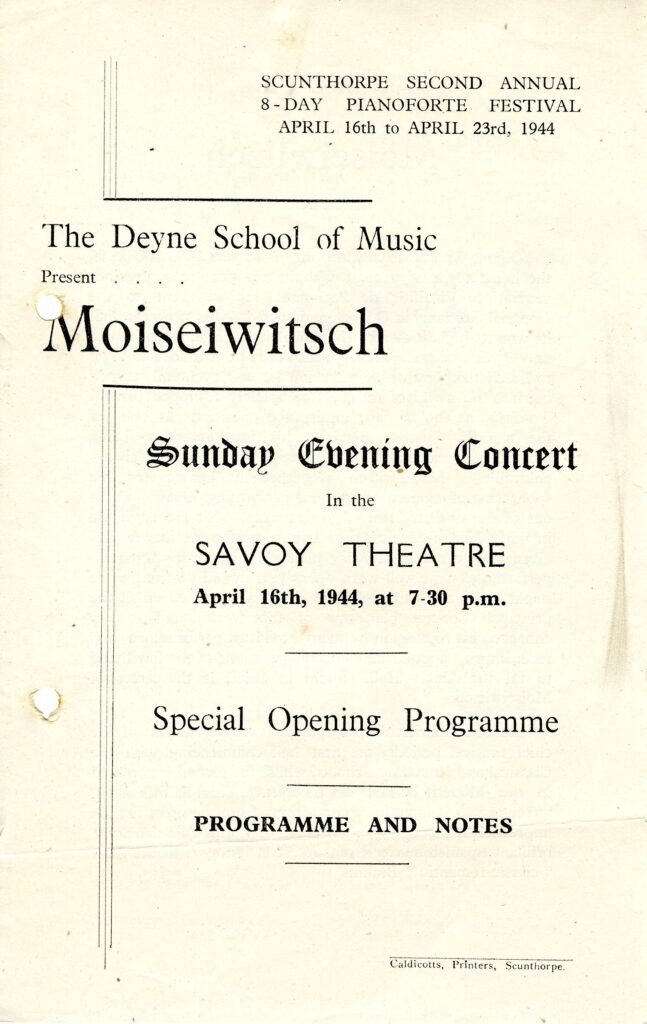
Born in 1890 at Odessa, Benno Moiseiwitsch was sent to the Imperial Academy. Such was his progress that he won the highest award, the Rubenstein prize, when he was only 9 years old. Shortly afterwards he was advised to go to Leschetizky, by whose attention he was eventually turned out into the world of music, a completely equipped pianist.
Moisewitsch’s programme is representative of the chief musical periods, the first half commencing with the Classical and Romantic schools. Whilst the second is confined to the modern school of thought. Unlike the 1943 non-competitive festival, this event was competitive. Class sessions for individual performers commenced on the morning of Monday 17 April. The adjudicators were Vivian Langrish, Reginald Paul and Egerton Tidmarsh and sessions were held in the Centenary Methodist Schoolroom until Friday 21April.
The adjudicators also gave a combined Brains Trust meeting and concert on Thursday 20 April. Another outstanding event of the week took place when the All Round Musicians presented their concert. The All Round Musicians” were the distinguished performers from each class, playing their best piece. The performer gaining the greatest number of marks received the All Round Musician trophy and a certificate. All performers gaining not less than 70% marks received certificates of merit. A shield of high value and several cups was also included in the trophies. On Sunday 23 April, also at the Savoy Theatre, the grand closing programme was concluded with a two piano-recital by the world-famous duettists, Louis Kentner and Ilona Kabos. They were supported by Barbara Fardell and the All Round Musicians, who must have felt very proud of performing in a concert with such distinguished guests.
“For teaching is only of whither and how to go, the vision itself is the work of him who hath willed to see.”
Plautinus
In memory of Laura Middleton & Percy Cossins – principals of the Deyne School of Music.
This article is the second in a three-part series exploring the history of the Deyne School of Music. Andrew Holmes is a Project Volunteer on the National Lottery Heritage Fund project Documenting Northern Lincolnshire’s History.