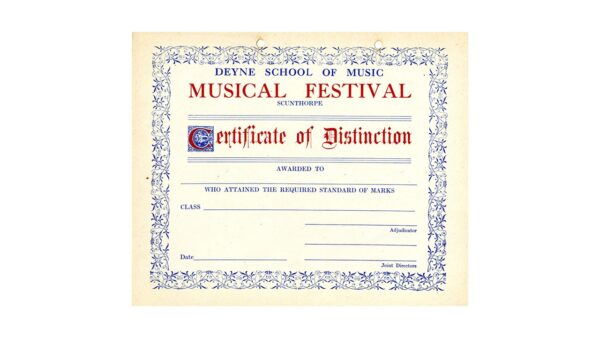
Deyne School of Music Part 3: Festivals 1945-1955
Andrew Holmes, Documenting Northern Lincolnshire's History Project Volunteer
Introduction
In 1943, Laura Middleton and Percy Cossins, a married couple in Scunthorpe, established a remarkable music school called the Deyne School of Music. This article is the final instalment in a three-part series exploring the history of the school.

1945
In the 1944-45 Annual Report, Deyne School of Music principals Laura Middleton and Percy Cossins look back at the first four years since the music school’s first annual concert took place. 1945 marked the school’s fifth annual concert, but also the momentous V.E year. The report includes that music was becoming part of everyday life, and music would “help sustain us” […] “perhaps at no other time in our history would music give us so much solace in times of so much trouble.”
“During those war years people of all ages were coming to us for music lessons, they came whether the sirens wailed, they came in the blackest of black out, and they came even if the bombs had fallen the night before […] We just could not cope with all the work.”
1944-45 Annual Report
Laura Middleton and Percy Cossins worked tirelessly throughout the war years to train additional teachers and in 1943 formed the Deyne School of Music, which steadily gained in prestige. By 1945, record numbers of students were recorded on the register. Successes were widely observed as students took part in varied musical activities connected with Scunthorpe’s cultural scene.
Cossins and Middleton were aware of the importance of bringing music to the local community and reflect in the report on their “cultivation and spreading of as much music making as we possibly can”. To this end, the report lists distinguished pianists invited to Scunthorpe by the principals. These include Moisewitsch, Mark Hambourg, Louis Kentner, Rawicz & Landauer, James Ching, Reginald Paul, Egerton Tidmarsh, Felix Swinstead, John Tobin and Tilly Connely.
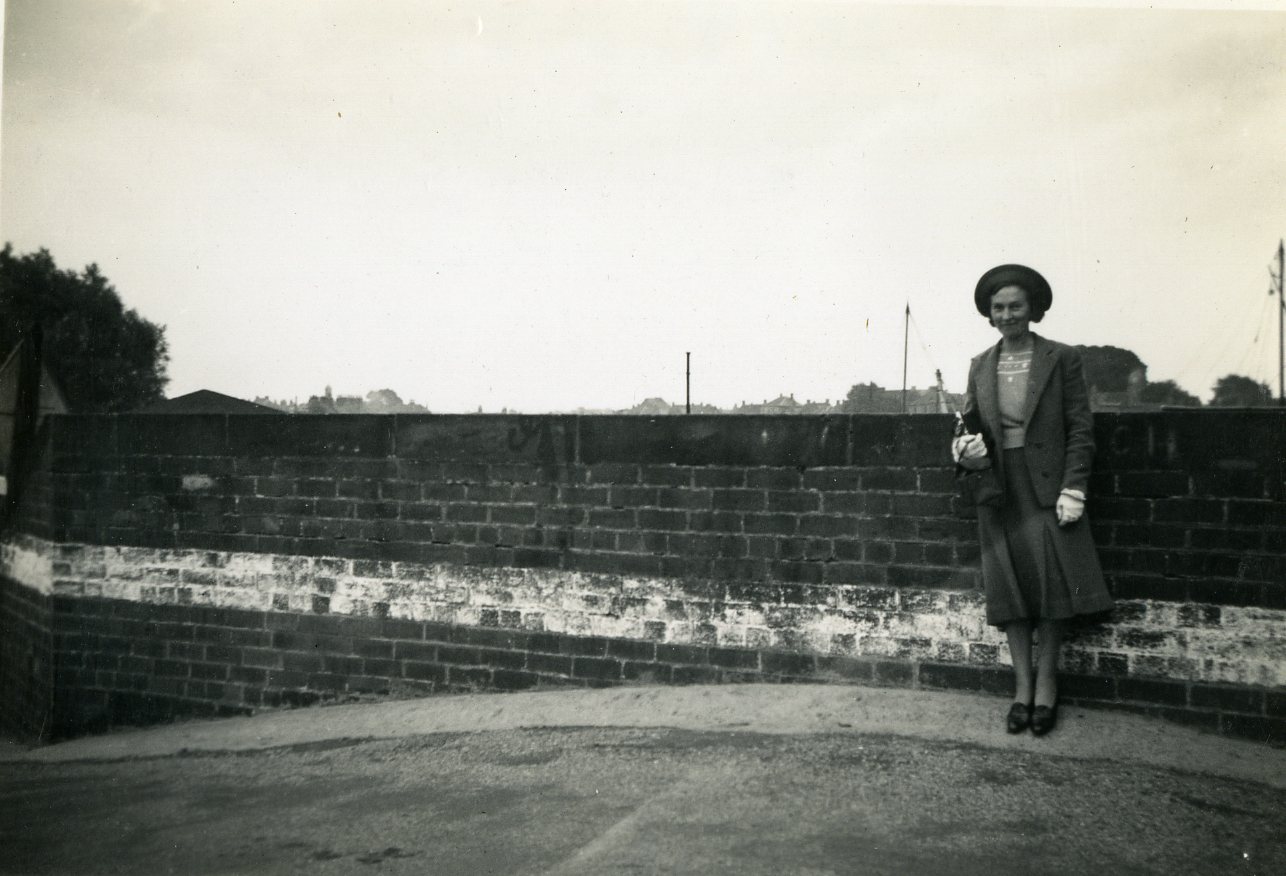
The school taught the syllabus assigned by the Associated Board of the Royal Schools of Music. For beginners, lessons included technique, reading exercises, aural tests, composition, and harmony. For more advanced students, Classical, Romantic and Modern mediums were introduced, together with duets for one and two pianos.
The report records that 123 students at the school were successful in their first attempt at the Royal School of Music examinations. In these examinations no less than 388 successes had been awarded in the 5 years up to 1945.
The report also mentions that a gigantic teaching effort was made during 1944, especially organising the 8-Day pianoforte festival and other concert work. They also document in this report that during the following year, they will need to take things easier. They question whether they can maintain such an output of work in the future and conclude that this remains to be seen. Their recognition of the importance of music during this period is apparent throughout the report. The principals state that no other art can draw people together and enjoy one common purpose. They hope that music will play its part in bringing countries and peoples together for lasting peace.
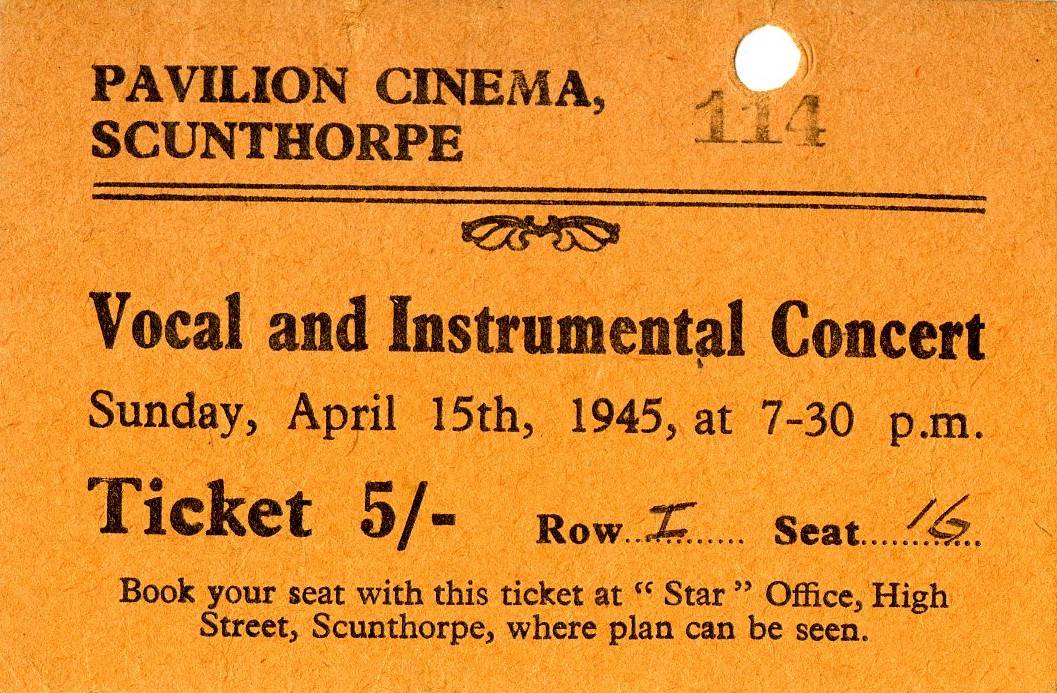
The fifth Annual Concert and Distribution of Diplomas and Certificates took place at the Savoy Theatre on Saturday 7 July 1945, with the highlight being a pianoforte Chopin recital by Miss Barbara Fardell. The recital included works such as the Valse in Ab, Nocturne in Eb, and the Scherzo in Bb minor. These works have become even more famous since the making of the biographical film, A Song to Remember (1945), telling the story of Frederic Chopin’s life as one of the greatest composers that ever lived. Picture goers may remember being thrilled by this film at the Majestic cinema in Scunthorpe a few weeks prior to the event. The mayor and mayoress of Scunthorpe, Councillor C.T. Goy and Mrs. Goy, presided. The mayor made the presentation of diplomas and certificates. Ambrose Coviello, professor at the Royal Academy of music, described the festival as unique in character. He was struck by the wisdom and imagination shown in the All Round Musician competitions.
1947
Possibly due to funding and high costs, it was not until 3 May 1947 that the sixth Annual Concert and Distribution of certificates take place at the Savoy Theatre. Under the patronage of the Mayor and Mayoress of Scunthorpe, councillor David Todd, J.P. and Mrs Todd, this gave the students the opportunity to perform in front of a large audience under real concert conditions. The highlight of the day was a two-piano recital by Jean Sutton and Alan Walker. Their main work was the Sonata in D by Mozart. The music ranged from the lively and strongly rhythmic, to the calm and serene with many tender and romantic moments. This was considered a real musical treat for the guests and was greatly appreciated.
1948
The Fifth Annual pianoforte festival was held at the Trinity Methodist schoolroom from Monday 29 March to Friday 2 April 1948. The opening ceremony was hosted at 6pm by the Mayor of Scunthorpe, councillor W.H. Pulling, supported by the Mayoress and others. The All Round Musicians concert and competition finals and distribution of certificates and prizes were held on the Friday evening and presented by the pianist and adjudicator, Maurice Cole.
1949
Maurice Cole was a distinguished pianist, and he delivered a recital at the Seventh Annual Concert and distribution of certificates. This was held at St. Paul’s Church Hall, Ashby on Friday 29 July 1949. The concert was performed in two sections: junior and senior. The junior section consisted of preliminary, primary, elementary, transitional and lower grade students. The charming author-pianist, Thora Hornsby, L.R.A.M., gave a short recital. The senior concert consisted of higher, intermediate, advanced and final grade students, and took place in the evening. The highlight of the evening was the return of Maurice Cole. Cole was fondly remembered by students for his wonderful adjudicating and delightful manner at the 1948 festival.
Earlier, in that same year, the sixth Annual pianoforte 4-day festival was held from Tuesday 19 April to Friday 22 April 1949 at St. Paul’s church hall. A key objective for performers was achievement in the All Round Musician competitions. There were three kind donors of cups. Mr and Mrs Ernest Stocks of Messingham donated the Stocks silver cup for junior repertoire. Mr and Mrs John Kitching of Barton-on-Humber donated the Kitching silver cup for senior repertoire. Miss Heather Woodbridge of Kirton Lindsey donated the Heather Woodbridge silver cup for section C All round musicians. Other cups awarded were the Deyne silver cup, as well as the much-coveted star shield presentation of the open All round musician trophy. This was awarded to the winner performing the highest average marks in the grade classes, Chopin or Beethoven and repertoire classes. Miss Gladys Puttick made the presentation of trophies and certificates at the climax of the festival on the evening of Friday 22 April 1949.
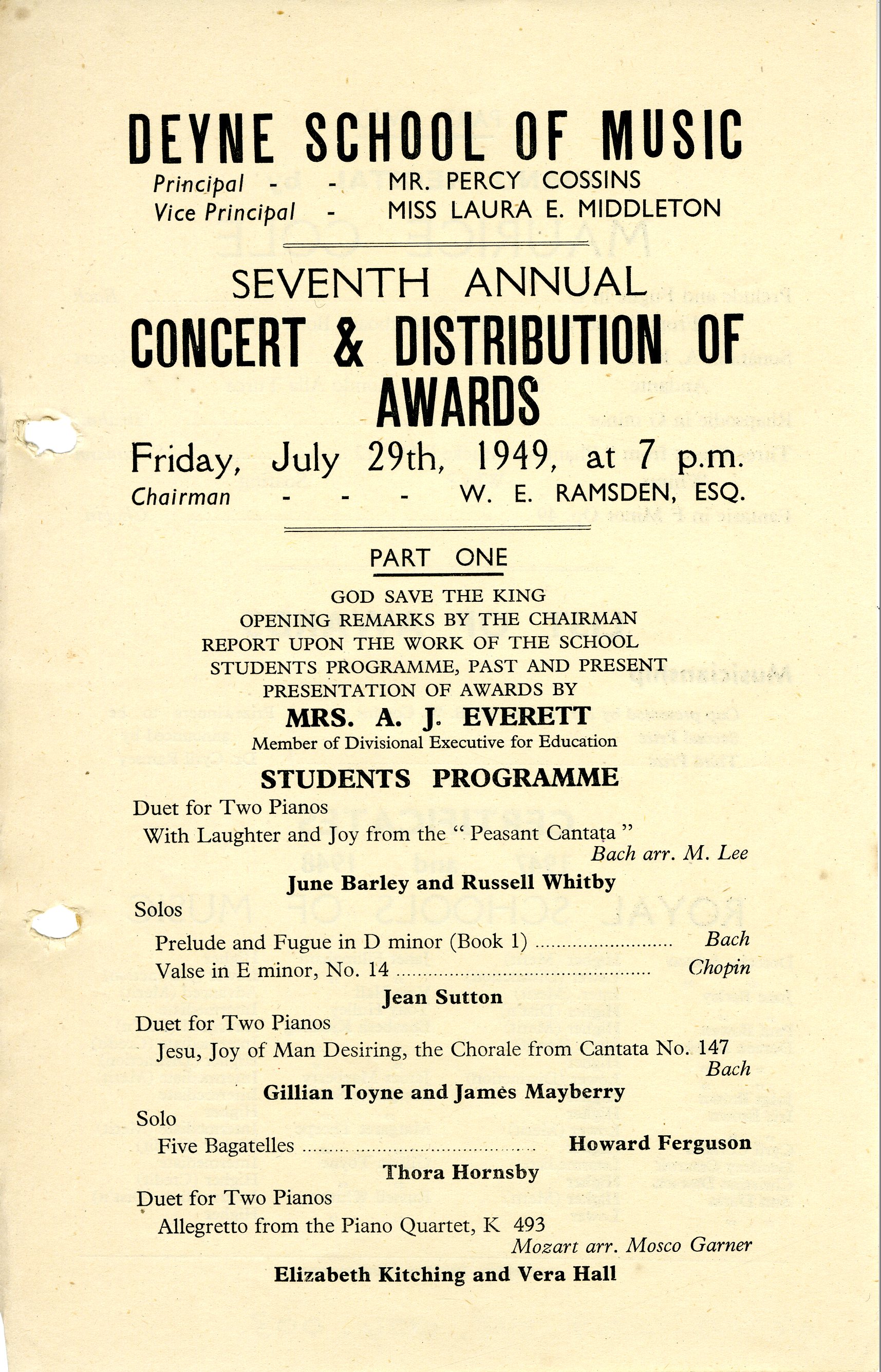
In the Deyne School of Music annual report of 1949, Middleton and Cossins remark how interest in music remains very much alive. They argue music continues to play a very active and important part in a surprisingly large number of people’s lives. The pair considered their teaching more so as a mission than work.
In the report, the principals also offer a breakdown of the term musicianship. They use the definition by lecturer and author, Dr William Lovelock, who, in his Art of Teaching says it is a correlation of listening, doing and performing. An absence of executive skill does not necessarily imply a lack of musical feeling. It is often found the one whose actual performance is of mediocre quality has yet quite a good natural appreciation of the beauties of music.
Middleton and Cossins clearly shared an interest in the pedagogy of music. They point out that musicianship seeks to improve and deepen an appreciation of the beauties of music. They aim to increase the student’s power as a listener so not only can they appreciate music as sound but also know and understand in detail what is happening. This aspect of listening cannot be cultivated simply by mere performance, untutored listening, or study of books, but by practical work dealing with the structure of music.
On a more practical note, they do also reflect in their 1949 report that administrative costs had risen enormously. The Deyne School of Music was a purely independent organisation, receiving no grants of any kind. However, this did not relax their efforts to produce exemplary musicians, as well as providing the very best in teaching.
Middleton and Cossins reflect on the remarkable talent of their students throughout their reports. The following excerpt from their 1949 report offers a prime example:
“Junior school teaching of musicianship has been encouraging and derives enormous cultural benefit. Children begin at 9-10 years, in some cases younger, and attend classes every week. By the age of 14-15 years they are experienced musicians, some having produced small compositions of their own which would probably astound experienced professional musicians. These boys and girls thus get a trained musical mind which enables them to take part in music wherever they may go. Senior students work on similar lines, only that such things as practical harmony, transposition, extemporisation, aural culture and a general keyboard initiative will be more advanced.”
In examinations, 70 students met the requirements of the Royal Schools of Music in a most satisfactory way, including five distinctions and twenty-nine merits. This contributed towards a grand total of over 800 successes during the previous nine years. Also, the 1949 festival was voted very successful when Mrs Gladys Puttick, a well-known and widely experienced educationalist, acted as adjudicator. Miss Puttick was agreeably surprised at the standard of performance during each day. The Deyne School of Music felt particularly proud of the pupils and the fact that the school dominated the sight-reading and ensemble classes, earning praise from the adjudicator for the many entries and good musicianship shown in these often-neglected classes.
1950s
From 1950 onwards, festivals were less frequent. The Seventh Annual pianoforte festival and All Round Musicians concert and competition finals were held at St. Paul’s Church Hall on the evening of Friday 30 March 1951. Mr Maurice Cole was the adjudicator and Mrs Maurice Cole made the presentation of prizes.
“Music is a moral law. It gives a soul to the universe, wings to the mind, flight to the imagination, a charm to sadness, gaiety and life to everything.”
Plato, as quoted in the Eighth Annual Concert and Distribution of Awards programme, dated Tuesday 22 February 1955.
“Television does not kill the music making desire.”
Laura Middleton and Percy Cossins, as quoted in Scunthorpe and Frodingham Star.
In the 1955 annual report, Laura Middleton and Percy Cossins remark that years ago, the cynic said the gramophone, the wireless, the cinema and television would soon kill the desire to make music. They add that advancements of these mediums in the previous few years brought about the exact opposite.
The two principals predict that when television is really organised there will be an even greater urge to perform. The T.V screen invites interest, they say, and more people will take up the playing of the piano and other musical instruments. The principals state they are delighted that more and more people are deriving pleasure by learning to play. This applies not only to children, but adults in all walks of life – the steelworker, teacher, mothers, fathers, and those in the forces. They also state they do enjoy teaching adults as they are keen and make good progress, and they enjoy meeting them each week.
The report predicts progress towards an age of technological and teaching innovation:
“Radio, films and television are not only going to influence, but will play a very important part in, the teaching world of the future. They are not stunts or entertainment as some of the old diehards would have us believe, but real educational aids.”
The Deyne School of Music believed in retaining all that is best in the old, whilst incorporating the best in the new, and it is in this spirit that they presented the Eighth Annual concert and distribution of awards in the Congregational church hall on 22 February 1955.
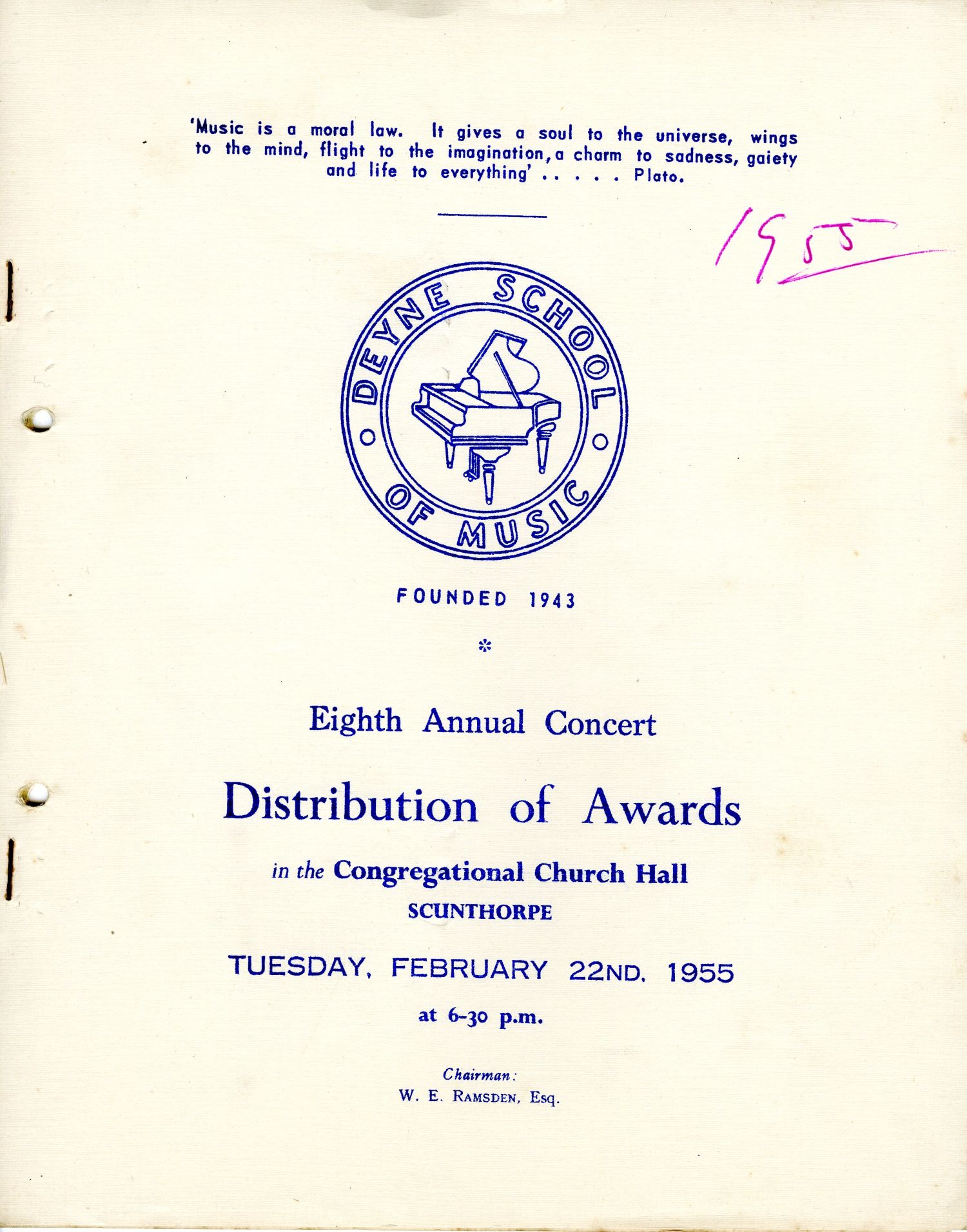
Playing to a packed audience of parents, friends, students and music lovers, the children showed some of the work they do throughout the year. They played pieces which varied from Sleighbells to Bach’s Prelude and Fugue in D minor and Greensleeves to Beethoven’s Variations in E Flat (Erocia) Op.35. It was an evening of contrasts. There were solos and quartets. There were bright, snappy pieces which six-year-old children played with enjoyment. There were poems to illustrate and tell the composer’s story. There were more difficult pieces which were played by the older children with the feeling of concert pianists. Over seventy children took part in the concert. They were congratulated by the chairman for the evening, Mr. W. E. Ramsden. Ramsden said that he was pleased to see culture had a place in the town. He stated, “This school arose in the middle of the greatest war in history, and it has flourished and gone from strength to strength ever since”. Over one hundred students received certificates for passing pianoforte examinations the previous year. The presentations were made by Dr. Martin Lindsay, who congratulated those taking part for their spontaneous and thorough playing.
Unfortunately, there are no more records of further festivals after this date, although the Deyne school of music still taught pupils until 1974. This is the same year Laura Middleton died at the age of 72, whilst still teaching with the skill and enthusiasm she had shown for half a century. Her loss would have been felt widely. I love music can mean much or little, but to Miss Middleton it meant everything. In the annual report of 1955, Laura and Percy concluded by saying they regarded their students as their friends, hoping students had the same feelings towards them.
“Music then comes into the orbit of things – and we live – if we have only opened the door a little way to enable our students to do this – we shall consider our work done.”
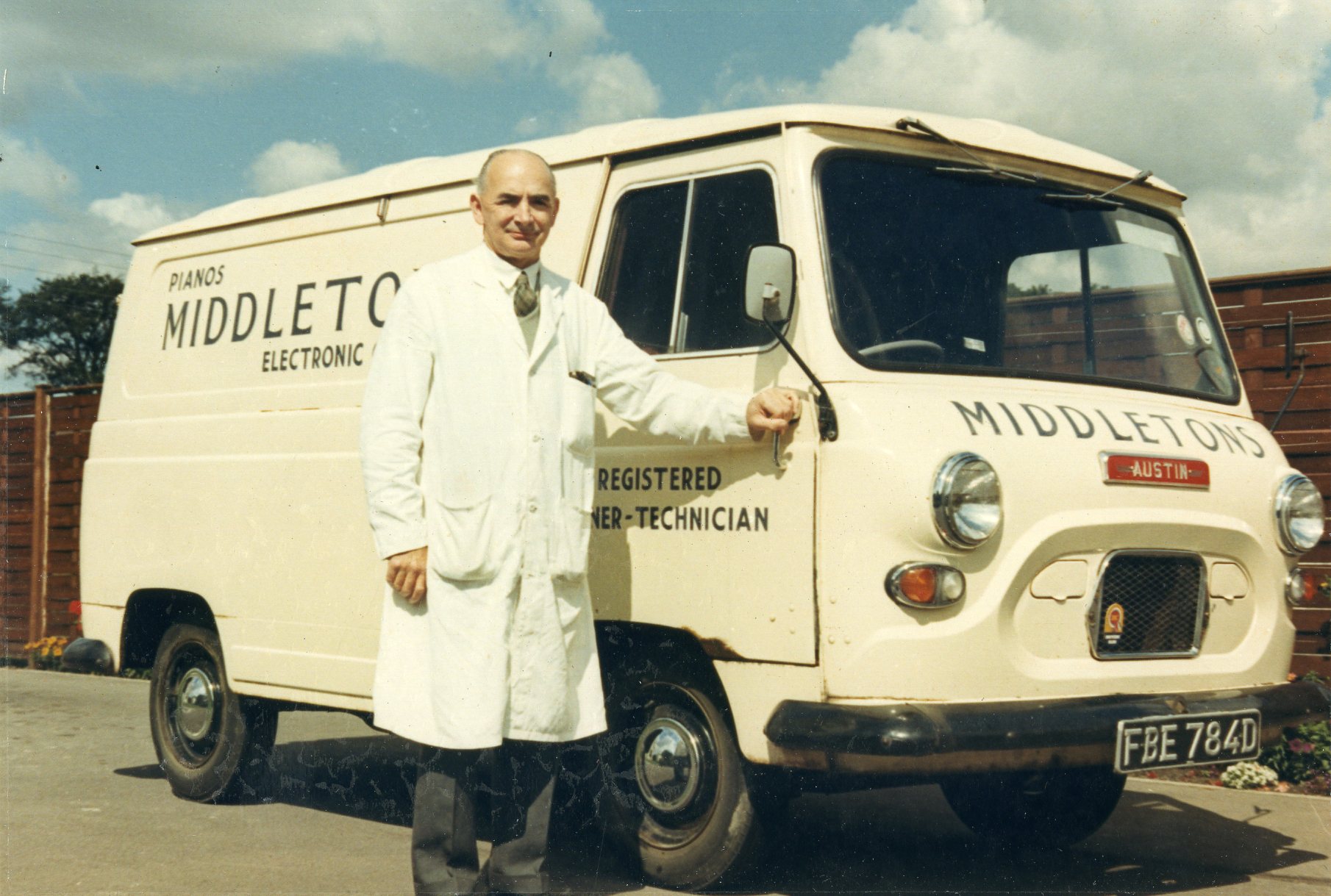
In memory of Laura Middleton & Percy Cossins – principals of the Deyne School of Music.
This article is the third of a three-part series which explores the history of the Deyne School of Music in Scunthorpe. Andrew Holmes is a Project Volunteer on the National Lottery Heritage Funded project, Documenting Northern Lincolnshire’s Local History.